December 24th, 2014
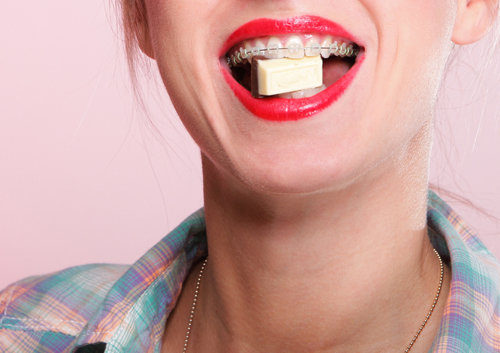
Sticky, hard, and gooey: these candies fill your dopamine receptors with spasms of sugar-filled joy, but if you’re undergoing orthodontic treatment at Nalin Orthodontics to straighten your teeth, then these sweets are not so sweet. While you may have a Willy-Wonka-sized sweet tooth, there are some candies you’re going to have to avoid while wearing braces.
Here are five bracket- and wire-destroying culprits that Dr. Andrew Nalin and our team recommend leaving on the candy aisle and not put in your mouth, no matter how tempting they may be.
- Gum is sticky and stringy. It can get tangled like fishing net in your braces. You don’t want to be that boy or girl trying to pull knots of Wrigley’s out of your braces without being seen.
- All chewy, gooey candies need to be avoided. When you’re wearing braces, don’t even think about putting a caramel candy in your mouth. Caramel will not only stick to your braces, making it look as if you haven’t brushed your teeth in a week, but the gooey texture can pull apart the wires, and trigger an emergency visit to Nalin Orthodontics.
- Hard candy may seem like a safe choice, but it’s not. What’s the problem? Nobody ever just sucks on hard candy; sooner or later, we bite down on it. Biting a hard candy may cause part of your braces to snap. Furthermore, once the candy is broken into a bunch of little pieces, it’s not uncommon for one of those sugary shards to get wedged between your braces and teeth … and that’s a cavity waiting to happen.
- The taffy you enjoy getting at a seaside boardwalk is going to have to go on the back burner. Like caramel, taffy can pull apart and damage your braces. You don’t want to have your expensive orthodontic gear replaced.
- Please, just one lollipop? Nope. A lollipop is nothing more than hard candy on a stick. If you can’t have hard candy during orthodontic treatment, then you shouldn't have hard candy on a stick either.
Have any more questions about what you can and can’t eat when you have braces? Please give us a call at our convenient Mount Vernon, WA office to learn more, or ask Dr. Andrew Nalin during your next adjustment visit!
December 17th, 2014

At Nalin Orthodontics, we aren’t just concerned with straightening your teeth and giving you the beautiful smile you’ve always wanted. We are also committed improving the oral health and the well-being of all our patients. Dr. Andrew Nalin and our team strive to serve our patients by educating them about their treatments, as well as making them feel as comfortable as possible during their initial consultations up until the day they complete their treatments.
Making our patients more comfortable with taking care of their braces in between visits increases the likelihood that they will complete their treatments successfully. We want you to know that if you should ever have any questions about your orthodontic treatment, whether it’s during your adjustment appointment or after hours, we are always here for you and your family.
Please do not hesitate to give us a call at our Mount Vernon, WA office or ask us any questions you may have on our Facebook page! We can’t wait to hear from you!
December 10th, 2014

So you’re about to get braces. Congratulations! You are taking a very smart step to improve the health of your teeth as well as get that killer smile in shape. But, as with anything that is good for you, there are a few things you will have to avoid while you “do your time.”
Some foods don’t do so great with braces. The foods listed below should be avoided while you are wearing your braces because they can pop the brackets and bend the wires. In other words, these foods can really ruin your day, and send you back to Nalin Orthodontics to get your braces repaired.
So before you hit the chair, hit the grocery and candy store – one last time – for:
- Beef jerky
- Raw carrots
- Taffy
- Pizza crust
- Bagels and other crusty bread
- Popcorn
- Hard candy
- Nuts and seeds
Dr. Andrew Nalin and our staff will give you more information about eating with braces. Some foods, such as apples, are okay as long as you cut them in pieces first. Others, like pudding and pasta, are fine just as they are. But then there is “the list”: the foods that are a big no-no and should be avoided. It won’t be forever, so hang in there.
Your braces time will pass before you know it and you can resume more normal eating. But before the braces go on, enjoy these tasty treats. Go ahead and indulge!
December 3rd, 2014

Orthodontic braces have been around for more than a century and have continually evolved over that time. Today’s braces are more discreet than ever, producing excellent results without being overly obvious during the corrective phase. If you are in search of an aesthetically appealing way of straightening your teeth, Dr. Andrew Nalin and our team at Nalin Orthodontics provide multiple options to choose from, including lingual braces and clear aligners.
Clear Aligners
Clear aligners are progressive-phase braces designed for patients who need mild-to-moderate correction of crowded or crooked teeth. This system includes a series of custom-made trays that gradually shift the teeth into their targeted positions. Instead of frequently returning to our Mount Vernon, WA office to have braces tightened, you simply swap the trays out every few weeks. Clear aligners are virtually undetectable and can be removed while eating or brushing your teeth. When worn as prescribed, these metal-free trays can straighten your teeth in as little as six to 12 months.
Lingual Braces
Lingual braces are similar to traditional metal braces in that they are fixed to the teeth. However, lingual braces differ in that they are attached to back of the teeth rather than the front. This type of treatment is preferred over clear aligners among patients with moderate to severe orthodontic correction needs. Lingual braces are non-removable and must be adjusted periodically during scheduled orthodontic visits. However, lingual braces are capable of producing much more controlled force during treatment, which can yield highly successful results.
If you think you may be a candidate for braces, but aren’t sure whether lingual braces or clear aligners are right for you, Dr. Andrew Nalin and our team can help you decide. Schedule a consultation today to find out more about your orthodontic options and start on the path to the beautiful, healthy smile you’ve always dreamed of.

 Website Powered by Sesame 24-7™