
Our Blog

What is malocclusion?

March 10th, 2021

The term malocclusion refers to misalignment of teeth. You may have been born with malocclusion, so your teeth simply grew in crooked, or the misalignment and crowding of your teeth occurred over a period of time. Either way, not only can malocclusion pose cosmetic issues, but it can have a negative effect on your speaking and eating abilities as well.

Types of Malocclusion

Malocclusion encompasses multiple types and classifications of misalignment issues, including twisting or rotation of the teeth and molars that do not meet when you bite down. In some cases, the top front teeth are pushed outward in an upper protrusion.

In other cases, a misplaced midline results when the front top teeth don’t meet with the front bottom teeth. Transposition occurs when teeth protrude through the gums in a position where another tooth is supposed to be.

Practically any type of crowding or spacing issues, rotation or twisting of the teeth, or bite problem – including overbite, underbite, open bite, or crossbite – is included under the umbrella of malocclusion.

Malocclusion Classifications

There are three classifications of bite or misalignment problem.

  • Class 1 malocclusion: While the bite may be normal, the upper teeth overlap the lower teeth slightly. This is the most common type.
  • Class 2 malocclusion: Known as overbite or retrognathism, class 2 involves a severe overlap of the upper teeth and jaw over the bottom teeth and jaw.
  • Class 3 malocclusion: Known as underbite or prognathism, class 3 occurs when the lower teeth and jaw overlap the upper teeth and jaw. Thus, the lower jaw juts forward.

Causes of Malocclusion

The most common cause of malocclusion is genetics. However, there may be other causes, including the development of abnormally-shaped teeth, lost teeth, or impacted teeth; thumb sucking or overuse of a pacifier as a small child; having fillings or crowns that do not fit correctly; a serious injury that causes misalignment of the jaw; or developing a tumor of the mouth or jaw.

Treating Malocclusion

Orthodontic care at Nalin Orthodontics with Dr. Andrew Nalin is the main treatment available for malocclusion, which includes getting braces, Invisalign, or other corrective treatments. Treatment is ideal not just to have your smile improved, but because it makes the teeth easier to clean and maintain, lowers the risk of gum disease and tooth decay, and can even take pressure off the jaw and teeth.

Think about orthodontic treatment if you (or your child) display any signs of malocclusion. Early treatment of malocclusion during childhood can lessen expensive treatment later on.

The Importance of Wearing Your Retainer after Orthodontic Treatment

March 3rd, 2021

It's the big day and your braces are finally coming off! Does that mean you are completely done? Not so fast! After you complete your treatment here at Nalin Orthodontics, Dr. Andrew Nalin and our team will recommend you wear a retainer, which must be worn routinely after treatment in order to hold your teeth in their proper, new position while your gums, ligaments and bones adapt. Most patients are required to wear their retainer every night at first, with many also being directed to wear them during the day. It's important to know there are different kinds of retainers, and today we thought we would explain the differences between them.

Hawley Retainers

The Hawley retainer is one of the most common types of retainers. It is a removable retainer made of a combination of a metal wire that typically surrounds the six anterior teeth and is designed to keep your teeth in place. This retainer is made from impressions of your teeth so that it fits snugly and comfortably in the roof of your mouth, while the wire and acrylic framing keeps your teeth in an ideal position. The acrylic can also be personalized with a large number of colors or patterns.

Essix (Clear) Retainers

The Essix retainer is a transparent removable retainer that fits over the entire arch of your teeth. This clear or transparent retainer fits over the entire arch of teeth and is produced from a mold. Similar to Invisalign’s clear aligner trays, Essix retainers have no metal or wires. They can also be used to produce minor tooth movements and can be helpful in prevention of tooth wear due to tooth grinding at night.

Bonded Retainers

Bonded lingual retainers are cemented directly to the inside surface of your lower canines. Dr. Andrew Nalin and our team at Nalin Orthodontics encourage our patients with bonded lingual retainers to be careful with their bite as the bonding material may break due to incorrect biting and cause your teeth to shift. As with removable retainers, it is important to keep your bonded retainers clean. When brushing, make sure to carefully clean the inside of your lower teeth, as well as the wire itself.

The retention phase of treatment begins when the patient’s braces are removed. Retainers are worn full time, typically for the first nine months, except while eating. Retainers should also be removed before brushing your teeth.

If you have any questions about the retainers we offer or to learn more about post-orthodontic treatment, please feel free to contact us at our convenient Mount Vernon, WA office and we will be happy to answer any of your questions!

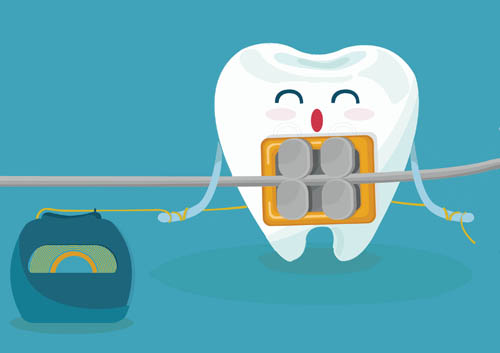
How to Floss with Braces

February 24th, 2021

The Nalin Orthodontics team knows that oral hygiene is important, whether you have braces on your teeth or not. But if you are a person who wears braces, caring for your teeth and gums can become somewhat challenging. Without daily oral hygiene practices, you may become prone to cavities and tooth decay during your time in braces.

Naturally, you know that brushing your teeth each morning and night, as well as after you eat, will help keep your mouth healthy and clean during the months you wear braces. But flossing is also an important part of your hygiene routine. Flossing with braces can be tricky, but it’s not impossible. Dr. Andrew Nalin, your general dentist, or your dental hygienist can help you become more comfortable and adept at flossing your teeth during the months you wear braces.

Flossing Tips for Those with Braces

  • Use Tools Provided by Our Office. A floss threader is a small, plastic needle that will help you floss between the wires and your teeth. Thread a 12-to-18-inch piece of floss onto the needle, and use the needle to get the floss easily behind the wires.
  • Flossing Under the Wires. Once the floss is behind the wires, use your hands to manipulate the floss. Move it up and down along the wires to remove food particles.
  • Flossing Between Your Teeth. Floss between your teeth as you normally would without braces. Move the floss up and down between your teeth, using a clean section of floss for each tooth.
  • After You Finish Flossing. Your orthodontist may have suggested that you use a water pik or proxy brush after you finish brushing. Either of these tools will help remove any loosened food particles to ensure that your teeth and braces are clean.

Continue Good Oral Hygiene Habits

Good oral hygiene habits you use while wearing braces will help you achieve the beautiful smile you and the Nalin Orthodontics team have been working toward. Once your braces are off, it may be tempting to slack off on the brushing and flossing. Don’t let yourself fall into any habits that will have a negative impact on your oral health or the attractive smile you waited for throughout the months you wore braces. See your general dentist for regular cleanings, and continue to brush and floss your teeth each day.

Orthodontic Treatment: Does a Missing Tooth Mean Missing Out?

February 17th, 2021

You’ve decided—now’s the time to talk to Dr. Andrew Nalin about straighter teeth and a better bite. So what’s holding you back? If you are concerned because you have a missing tooth, don’t let that stop you from making that first appointment. Orthodontists today have many options to help you achieve the benefits of a more attractive, and even healthier, smile.

How can we accommodate a patient with a missing tooth or teeth? Because each patient is different, our approach will be tailored to your specific needs.

A Lost or Missing Permanent Tooth

There are a number of treatment options available, depending on the position of your other teeth.

  • If your teeth are already crowded, it might be possible to close a small gap left by a missing tooth with braces.
  • If the space between your teeth is the perfect size for a replacement tooth, your orthodontic appliance will keep that spot open as your braces move the rest of the teeth into alignment.
  • If you need more space for a replacement tooth, braces can help widen the space between your surrounding teeth for an ideal fit.

Tooth loss can occur for a number of reasons. Accidents, decay, and gum disease can lead to tooth loss.  Congenitally missing teeth, teeth that simple never developed, are also a fairly common condition. But missing teeth are not merely a cosmetic issue, and should not be ignored. A gap in your smile can lead to shifting of the teeth around it, bite problems, difficulty chewing, and gradual loss of bone tissue beneath the missing tooth.

Today’s implants are a permanent, natural-looking replacement for a lost tooth. If you decide that an implant is your best option for tooth replacement, you are still a candidate for orthodontic treatment. Dr. Andrew Nalin and your oral surgeon can decide on a schedule that will provide the best timing for each phase of your treatment.

A Lost Baby Tooth

Finally, let’s not forget younger patients. Sometimes children benefit from orthodontic care before all of their adult teeth have erupted. If your child has lost a baby tooth too early, a space maintainer can be used to prevent shifting and misalignment of the remaining baby teeth and leave room for the adult tooth to erupt in its proper spot.

We recommend that your child have a first orthodontic assessment around age seven, but if your child has lost a primary tooth before its time, give our Mount Vernon, WA office a call. We can let you know if a space maintainer is the best way to prevent future dental and orthodontic problems.

If you have concerns about a missing tooth or teeth, talk to us! Orthodontic treatment is always custom-designed to fit the needs of each individual patient. We can discuss your specific goals, and how orthodontic treatment can help you achieve them. There is no reason to let a missing tooth keep you from a more attractive, healthier smile!